
The leaves are changing colors and there’s finally a chill in the air – it’s feeling like fall!
And with fall comes the sniffles. They’ve been going around my husband’s workplace for weeks. So far, he’s stayed healthy, but I’m adding all of the immune-boosting and nutrient-dense foods to keep it that way!
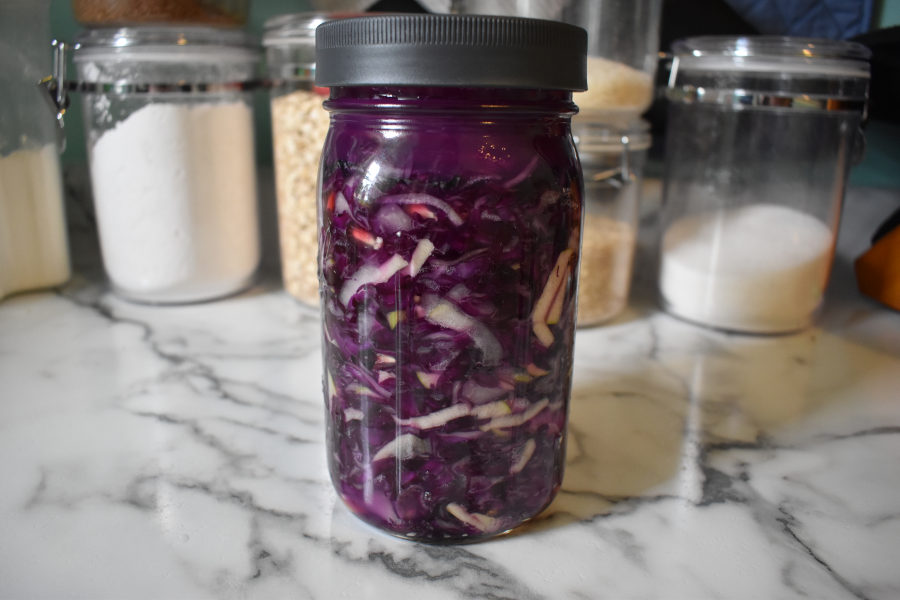
Enter this purple sauerkraut, with red cabbage, apple, pomegranate, and red onion. In terms of flavor, it’s the perfect burst of fall flavors! I love it with some shredded pork shoulder or on top of a salad. And I’m certain that it will be the perfect addition to my Thanksgiving spread to cut the richness of all the other dishes.
But what I really love is that it also packs quite a punch in terms of nutrients.
Sauerkraut is rich in probiotics (even more so than a probiotic supplement), thanks to the fermentation process, which makes it a gut health superfood. And a healthy gut has been shown to support the immune system – something we all desperately need in the colder months!

Red cabbage, apples, pomegranates, and red onion are all known for being rich sources of antioxidants (including vitamin C). Antioxidants fight free radicals in the body to protect it from oxidative stress (a cause of many chronic diseases, from heart disease to cancer). Antioxidants are especially important in the fall and winter, as high blood sugar (from indulging in holiday treats), alcohol consumption, stress, and infections can all lead to increased free radical formation.
All the ingredients in this purple sauerkraut are also known for being anti-inflammatory, which is excellent anytime, but especially during this time of year when stress is higher and we (or at least I) tend to eat more inflammatory processed foods than normal due to travel and the holidays. I’ll take all the help I can get, especially when it tastes this good!
Best of all, the fermentation process makes all of these nutrients even more bioavailable than they are in their raw forms. What’s not to love?

What is fermentation?
Fermentation is a traditional and very effective method of food preservation that uses the activity of naturally present yeast and/or bacteria to convert starches and sugars into acids and alcohols. This gives fermented foods their characteristic tang. It relies on a type of anaerobic metabolism (happens without oxygen), which is why it is important to keep the kraut beneath the brine while it is fermenting.
Sauerkraut is just one type of fermented food. Others include sourdough, yogurt, cheese and alcoholic beverages.
What are the benefits of fermentation?
As a method of preservation, fermentation is unique. While canning, freezing, and dehydrating leads to the loss of certain nutrients, fermentation preserves or enhances the nutrients in the raw food and provides probiotics. This means that fermenting foods actually makes them healthier than when they were fresh!
A 2023 study on the nutritional quality and health effects of certain fermented vegetables and legumes provides greater details on how this is possible. Because fermentation reduces antinutrients like tannins and phytates in vegetables, it makes it easier for the body to absorb calcium, iron, and zinc that are otherwise blocked. Fermented vegetables are also notably higher in vitamin K, thiamine (vitamin B1), riboflavin (vitamin B2), vitamin B12, and folate – all produced by the beneficial microorganisms as a by-product of fermentation. Another result of fermentation is a lower glycemic index, as the microorganisms consume the starch and produce resistant starch.
When I can preserve a food with fermentation, it’s my top choice for logistical reasons as well. There’s no need to crank the air conditioner in summer after spending the afternoon canning. I don’t have to give up precious freezer space. Aside from a little bit of time chopping and filling the jar, it’s very low maintenance and always seems to turn out wonderfully.

Is fermentation safe?
I have never had an issue with fermented food, but as with anything you make at home, you should use your best judgement. If it looks, tastes, or smells off, exercise caution and do some research before you consume it.
Some things, like kahm yeast (which is a white layer that forms on the top of a ferment), can be safely skimmed off. Other things, like mold, are typically not safe and should be composted or thrown out.
That being said, I have found that using clean equipment, adding the proper quantity of salt, and ensuring that the vegetables are completely submerged below the brine prevents most problems.
How do I cut a pomegranate?
It’s not as hard as you might think!
Begin by cutting the bud end off. Next, score the pomegranate in quarters. Finally, break the pomegranate apart and gently knock the arils out into a bowl. Enjoy!

Ingredients
- 1 red cabbage (about 700g), finely shredded (about 1/8 to 1/4-inch thick) – Every cabbage will be a slightly different size, so just adjust the ratios to suit your cabbage. This recipe (and fermentation in general) is very forgiving as long as you get the salt ratio right!
- 20g coarse sea salt – salt should be 2% by weight of the other ingredients. Note: Do not use iodized salt as it can kill the lactobacilli that will do the fermentation! Also, check your salt to make sure it does not have any anticaking agents or other additives.
- 100g apple, thinly sliced – I used Granny Smith, but any apple will work!
- 100g red onion, thinly sliced
- 100g pomegranate arils (pomegranate seeds) – see above for how to easily cut the pomegranate and release the arils, or go here for a more detailed explanation!

Directions
Step 1: Put the finely shredded red cabbage into a large bowl and sprinkle it with salt.

Step 2: Massage and squeeze the cabbage with your hands to work the salt into it. It should gradually soften, become translucent, and release its liquid after about 5 minutes.

Step 3: Once the cabbage has released a significant amount of liquid and becomes very soft, mix the apple, onion, and pomegranate seeds into the cabbage.
Step 4: Transfer the mixture to a clean quart mason jar, using your fist or kraut tamper to pack it in (up to the shoulders of the jar), pressing firmly to release more liquid. Make sure the kraut is submerged completely below the brine using a fermentation weight or a cabbage leaf or two. If necessary, add some brine from the bottom of the bowl.

Step 5: Seal the jar. If your lid does not have an airlock, burp daily to release built up gases. Taste at about two weeks (or when fermentation activity slows down) to see if you like it. If it is not “sour” enough yet (or tastes too raw/salty), let it ferment another couple days, then taste again. Three weeks was just about perfect for us, but let your taste buds guide you!

Equipment
*Disclosure: I only recommend products that I use or would use myself. The links above are affiliate links, which means that I earn a commission (at no cost to you!) if you make a purchase using the link.

Purple Sauerkraut (Red Cabbage with Apple, Pomegranate & Red Onion)
This antioxidant-rich purple sauerkraut is made with red cabbage, apple, pomegranate, and red onion. It’s the perfect fall topping!
- Total Time: 2-3 weeks
- Yield: 1 quart (about 64 servings)
Ingredients
- 1 red cabbage (about 700g), finely shredded (about 1/8 to 1/4-inch thick)
- 20g coarse sea salt
- 100g apple, thinly sliced
- 100g red onion, thinly sliced
- 100g pomegranate arils (pomegranate seeds)
Instructions
- Put the finely shredded red cabbage into a large bowl and sprinkle it with salt.
- Massage and squeeze the cabbage with your hands to work the salt into it. It should gradually soften, become translucent, and release its liquid after about 5 minutes.
- Once the cabbage has released a significant amount of liquid and becomes very soft, mix the apple, onion, and pomegranate seeds into the cabbage.
- Transfer the mixture to a quart mason jar, using your fist or kraut tamper to pack it in (up to the shoulders of the jar), pressing firmly to release more liquid. Make sure the kraut is submerged completely below the brine using a fermentation weight or a cabbage leaf or two. If necessary, add some brine from the bottom of the bowl.
- Seal the jar. If your lid does not have an airlock, burp daily to release built up gases. Taste at about two weeks (or when fermentation activity slows down) to see if you like it. If it is not “sour” enough yet (or tastes too raw/salty), let it ferment another couple days, then taste again. Three weeks was just about perfect for us, but let your taste buds guide you!
Notes
- Every cabbage will be a slightly different size – just adjust the ratios to suit your cabbage. This recipe (and fermentation in general) is very forgiving, as long as you get the salt right. The key is to use about 2% salt by weight of the other ingredients.
- I love a long ferment for the flavor, but it’s hard to be patient! For me, the best balance between flavor and time is just a bit after the fermentation activity slows down (less bubbles, color has finished changing), at around 2-3 weeks depending on the temperature of my kitchen.
- Prep Time: 20 minutes
- Fermentation Time: 2-3 weeks
- Cook Time: 0 minutes
- Category: Side Dishes
- Method: Fermentation
- Cuisine: German
Nutrition Facts
Amount Per Serving (1 tablespoon)
Calories: 5 kcal
Fat: 0g
Total Carbohydrates: 1g
Fiber: 0g
Protein: 0g
The nutrition data provided here is for informational only and is only an estimate based on an online nutrition calculator. It cannot be verified or guaranteed, and should not be used in the treatment of medical conditions. It should not be considered a substitute for a professional nutritionist’s advice This data should be interpreted and used at your own risk.





Leave a Reply