
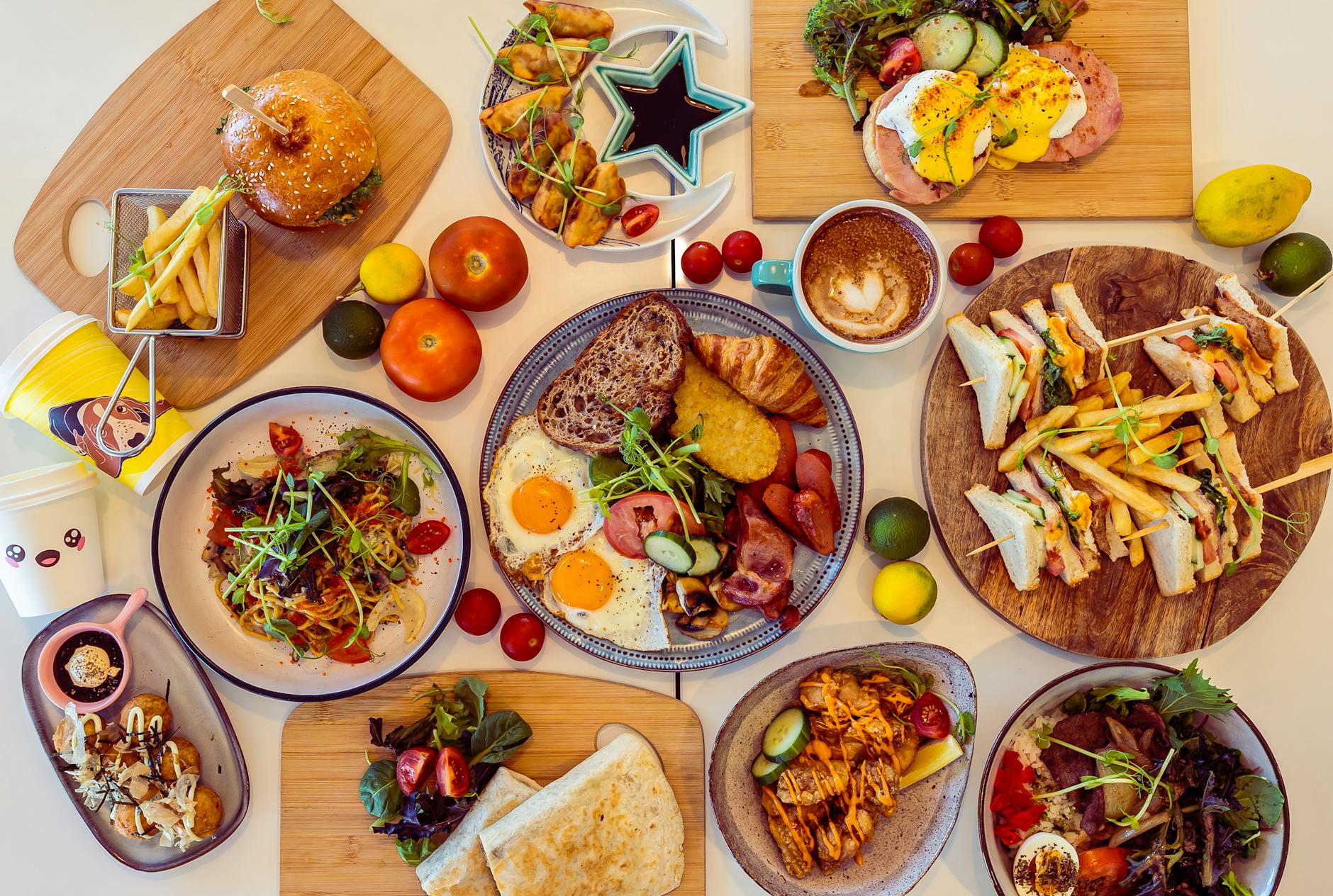
Have you tried intuitive eating?
Maybe it worked for you. But perhaps it didn’t – not at all.
My first experience with intuitive eating was a bust. I was freshly out of college, newly married, and wanted to get out of the restrictive eating cycle and diet mindset I had been in for years. I hoped that if I let my body tell me what and how much to eat, I would feel my best.
With no “good” or “bad” foods, I would pick many healthy, nourishing foods with occasional treats that nourished me in other ways – right?
Alas. It turns out my body wanted a lot of food that didn’t make me feel good. Specifically, it was a lot of “ultra-processed” foods, as I now know it. Food that is designed to be craveable, engineered to be nearly impossible to stop eating.
Nothing felt intuitive. I felt out of control. Why didn’t I feel satisfied? Why couldn’t I stop at “comfortably full’? I felt like I couldn’t trust my body because I wasn’t feeling better, physically or emotionally.
I knew that my intuition wasn’t leading me to make healthy choices. But I also knew that restricting food and following strict diets wasn’t sustainable or healthy either.
Was my body just broken?

Where Intuitive Eating Goes Wrong
The problem isn’t my body or your body or anyone’s body. In fact, our bodies are able to moderate our weight, metabolism, and caloric intake with the same precision that they moderate our internal body temperature. You don’t have to think about anything to maintain a stable (approximately) 98.6°F, or actively try to get warmer to induce a fever. Your body just does it. Naturally and unconsciously. It should be the same with our weight.
The problem also isn’t intuitive eating. At its core, intuitive eating actually makes a lot of sense. It’s how humans have eaten for most of history, so it should work. But, for most people, it isn’t working.
The problem is our food.
The food we eat today largely does not resemble what our bodies recognize as food. It’s full of artificial ingredients, or ingredients removed so far from their natural state that our bodies no longer recognize what they are or how to use them.
When we taste sweet, our bodies expect a certain amount of calories. But with artificial sweeteners, that’s not what they get.
The same thing happens with fat. When we feel the silky richness of fat in our mouth, our bodies expect a certain amount of calories. But with ingredients like carrageenan and whey protein concentrate imitating the “mouth-feel” of fat while not delivering the caloric payload, our bodies learn that they can’t trust our tastebuds.
It happens yet again with flavor and nutrients. With artificial flavors (or even “natural” flavors, which are processed to the point of basically being artificial), our bodies expect to receive the nutrients that go along with those flavors. But a strawberry-flavored Skittle doesn’t have the nutrients of a strawberry and an orange-flavored soda is a far cry from the nutrients of an orange.
How can we expect ourselves to practice intuitive eating when, for our bodies, their is nothing intuitive about our food?

Our Bodies Don’t Like Mixed Messages
It turns out that those mixed messages wreak havoc on our bodies. In The End of Craving, Mark Schatzker discusses a 2017 study that involved people drinking five differently colored beverages, each sweetened to the same degree with the artificial sweetener sucralose with varying caloric payloads (0 calories, 37.5 calories, 75 calories, 112.5 calories, and 150 calories) provided by maltodextrin, a flavorless starch.
Which drink do you think that the hungry participants desired the most, according to their brain scans?
Considering that all the drinks tasted the same, but delivered different amounts of energy, the scientists had hypothesized that the subjects would prefer the 150 calorie drink. This would be in line with animal studies that showed that rats who had lost the ability to taste sweetness still preferred the higher caloric sweet water to the plain water when they were hungry. Their stomach had communicated to their brain which water contained energy and they naturally sought it out, without being conscious of the reason for their drive.
This was not the case with the humans. They preferred the 75-calorie drink. By a considerable margin.
Why the 75-calorie drink, not the 150-calorie one?
It turns out that the beverages had been sweetened to taste like they had exactly 75 calories-worth of sugar.
The researchers wanted to know how this intuitive sugar sense impacted metabolism. They put the subjects an indirect calorimeter to see how many calories their bodies burned. When they drank the 75-calorie drink, they burned 75 calories. It was like their bodies knew exactly what to do with the surplus calories.
But here’s where it gets weird. When they drank the 150-calorie drink, they didn’t burn any calories.
None.
In fact, it seemed like when they drank the beverages with mismatched calories and sweetness, their bodies gave up on trying to metabolize them.

Nutritive Gambling
Another point in Schatzker’s book is that these artificial ingredients in our food teach our bodies that food is uncertain. Like a gambler making riskier and riskier bets to try to “win big” because they’re afraid to lose money, our bodies produce more dopamine (more cravings) when it’s not clear that food is going to provide the energy it seems to promise.
A 1993 study at Stockholm University found that when gerbils were placed in an environment with varying amounts of food (an unstable food environment), they ate significantly more than gerbils in a stable food environment. They quickly gained weight.
The gerbils always had more food to eat than they were capable of eating. Yet their bodies went into panic-mode simply because of the instability. Why? Because their bodies knew that the time to store fat is not during a food shortage. That’s too late. You have to begin at the first hints of a food shortage, when the food environment becomes unstable.
Food insecurity is a predictor for obesity in humans too. Whether it is poverty that makes the next meal uncertain or if it is a restrictive diet, our bodies are more inclined to seek food and hold onto fat when they aren’t sure when the next meal will come or if it will provide sufficient energy.
It’s a strong case against overly-restrictive diets.
But it’s an even stronger case against foods with built-in uncertainty. It’s why it’s so hard to intuitively eat foods that are designed to trick our tastebuds.

Intuitive Eating: The Right Way
The trick to eating intuitively is to eat real food. That means eating foods without ingredients that are meant to trick our bodies.
This is where it gets tricky. Food companies try to hide those ingredients and are quite clever in doing so. “Yeast extract” is a sneaky name for MSG. Artificial sweeteners are everywhere. “Whey protein concentrate” is actually a fake fat. “Natural flavors” are basically artificial because they’re processed beyond recognition (Mark Schatzker goes into this in great deal in his other book, The Dorito Effect).
So how can someone eat real food?
Buy the ingredients (or single-ingredient foods). Cook from scratch. Don’t fall for the healthy claims on the package. Read the ingredients. If an ingredient isn’t something I might have in my kitchen, it’s probably not something my body will recognize either.
It’s no longer good enough to ask “would my grandparents recognize this food?” because food companies have been messing with our food for over a century. Instead, I ask “will my body recognize all of these ingredients as food?“
You can actually intuitively eat “treats” while eating real food
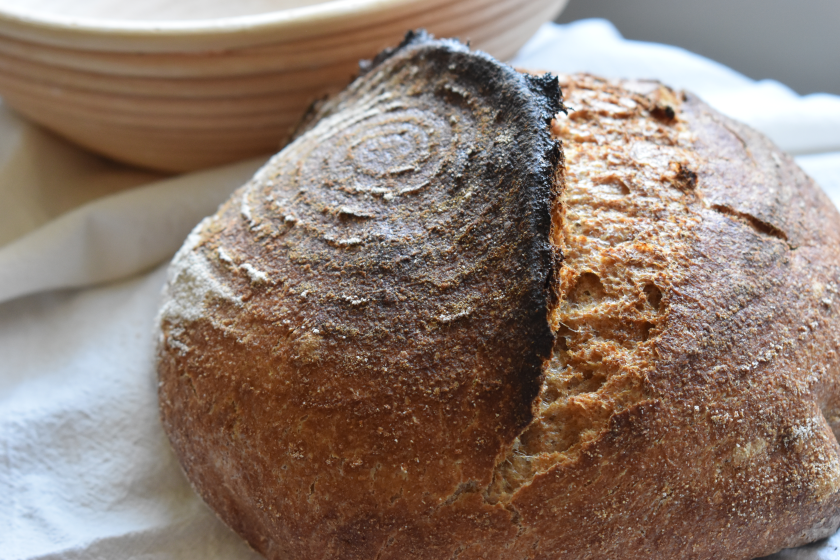
In addition to cooking from scratch, I also started to bake with sourdough and mill my own flour. Because flour in the grocery store is stripped of its natural fat, fiber, protein, and micronutrients and artificially enriched with a handful of vitamins, I found that I struggled to eat it intuitively. It may be different for you.
However, once I started to mill my own flour, I found that I no longer felt out of control around flour-based products. I didn’t overeat pasta, bread, or even sweets if I made them with long-fermented sourdough and fresh-milled flour. They tasted better, yet I craved them less because they were deeply satisfying in a completely new way.
I eat desserts as a (very) occasional treat, just once or twice a week. I’ve found that I don’t crave them anymore. Most nights, I eat fruit for “dessert” – something I once thought only crazy people did. I’m still shocked by how much my tastes and preferences have changed as my body adapts to real food.
Processed foods aren’t completely off-limits
On special occasions and in social situations, I still eat processed foods, but it’s not 80/20. It may have started about there, but it’s probably less than 95/5 at this point. And the more real food I eat, the less processed foods I want.
I no longer have cravings. Even in pregnancy (though I did have aversions early on). For the first time in my life, the food noise has gone silent and I feel peace when I sit down to eat.
When I do eat processed foods, I don’t feel guilty. But I do recognize that my body doesn’t feel as good as it does normally. I also notice that those foods don’t satisfy or give me real enjoyment, just a temporary high that leaves me unfulfilled.
In a perfect world, maybe I wouldn’t eat processed foods. However, I believe that fellowship is essential and sharing food with others is a big part of that. When others share processed foods, I enjoy them because it’s part of spending time with loved ones.
With a primarily real food diet, I don’t feel like processed foods are “off-limits” or that I “fell off my diet.” It’s a deviation from my normal pattern, which I can pick up at my next meal without any ill-effects or guilt. One snack or one meal (or even a whole week of meals on vacation) isn’t going to make or break anyone’s health.
It’s the overall pattern that counts.

What is your experience with intuitive eating? I’d love to hear your thoughts in the comments below!


Leave a Reply