
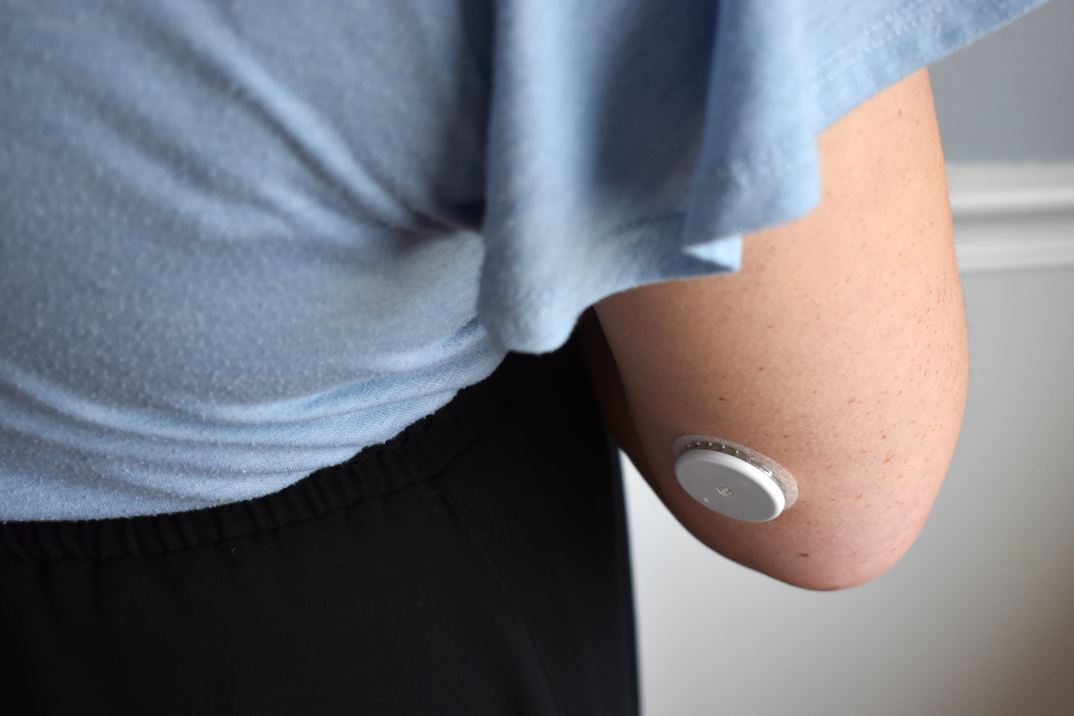
Instead of drinking the Glucola as I did in my first pregnancy, I decided to test for gestational diabetes by wearing a continuous glucose monitor (CGM) for two weeks.
It’s amazing to be living at a time when CGMs are widely available and affordable for the average person through over-the-counter options, like Abott’s Lingo and Dexcom’s Stelo. Both options are intended for non-diabetics, are HSA/FSA eligible, and are available without a prescription. While insurance won’t cover it, they only cost about $40-50 per two-week sensor.
I knew that wearing a CGM would give me more information than the single data point that the traditional Glucola test would give me. Even the 50+ data points of finger-prick glucometer readings would pale in comparison. What I didn’t realize was just how valuable the near-real-time feedback about my blood sugar would be.
Do I have gestational diabetes?
It doesn’t appear so, especially when I eat my normal, whole food diet. Predictably, refined carbs and especially refined sugar seem harder for my body to handle. Even though they didn’t send me out of range (63-140 mg/dL in pregnancy), they didn’t make me feel good and often left me unsatisfied and hungry. I didn’t spend much time eating that way once I saw why it made me feel worse than my normal diet!
However, I definitely could see signs of the insulin resistance that is normal in pregnancy. When I compared my body’s response to my husband’s, I saw was having a harder time metabolizing larger carb loads. While the peak numbers were similar, my blood sugar rose higher above my baseline (lower due to pregnancy). They also remained elevated longer before returning to baseline.
How is testing for gestational diabetes by wearing a CGM different from the Glucola test?
I will note that testing by wearing a CGM is a bit different than the traditional gestational diabetes screening. It doesn’t give you a firm yes/no diagnosis. You could even theoretically cheat by eating differently than normal. For some healthcare providers, that makes it a non-negotiable.
However, for others (like my amazing midwife), a yes/no diagnosis isn’t so much the goal. Good blood sugar control is. And after having a 9lb 8oz baby the first time around, that’s my goal too! With no reason to “cheat,” I was free to eat normally for a week to see my baseline, then really experiment and push myself the second week if the first week was in range.
Testing in this way gave us the information that my blood sugar control was great on my normal diet (and even when I pushed it), but it also led to some major “aha!” moments, as well as more minor insights that will influence my dietary choices moving forward, both during and after pregnancy.

Big Picture Takeaways from Wearing a CGM
1. Blood sugar fluctuates much more than I realized.
Blood sugar fluctuates from day to day and moment to moment. Sleep, stress, movement, and even what I ate in the previous 24-48 hours all had an impact.
Some days, my fasting blood sugar, as well as my baseline between meals, would be a bit higher or lower, and it usually took me a moment of reflection to understand which factors were at play. Often, it was several factors, not just one. Metabolic health is not just about food, sleep, stress, or exercise individually, but each of those absolutely does play a role.
Those factors also impact each other. Higher or more variable blood sugar at night (i.e. from a dessert or snack) often coincided with worse sleep. That, in turn, would lead to a higher baseline and greater glycemic variability the next day. The effect wasn’t dramatic, but it was a vicious cycle that required some effort to break.
Once during the experiment, I had a very pronounced “Dawn effect,” with my blood sugar jumping up 20+ mg/dL above my actual fasting level right after I got out of bed. A finger-prick glucometer reading at the wrong time could have given me the impression that my fasting blood sugar was significantly higher than what it actually was. In those cases, I was glad to have the context from wearing a CGM.
The same meal didn’t always result in the same blood sugar response either. Specifically, poor sleep, stress, and eating more carbs than usual in the preceding 24-48 hours seemed to lead to exaggerated blood glucose responses (and higher baselines). And when I had those exaggerated blood glucose responses, I noticed I felt worse, which brings me to my next point.
2. I had no idea what high or low blood sugar felt like until I wore a CGM
I know I’ve experienced both high and low blood sugar at different points in my life, probably at least several times each every week. But until I wore a CGM, I didn’t know that those feelings were related to specific blood sugar states.
When I had higher blood sugar, I felt absolutely wired. Like I had consumed way too much coffee, even if I hadn’t had a sip of caffeine. It was hard to focus and I noticed that I was fidgety in a way that I usually am not. If I had the choice, I would stand instead of sit or even pace. My body was clearly trying to activate my muscles to take up that extra glucose to bring me back down to baseline.
On the other hand, if my blood sugar dipped at all below my baseline for the day, I would feel hungry (and sometimes a bit shaky if I didn’t eat something quick enough). It was different from snacky-hungry, where certain foods sound good. Instead, it was a real, almost gnawing hunger. I could feel it throughout my body. Interestingly, it wasn’t a specific number that triggered it – it was when it dropped below where my body wanted to be that day. The best solution? A small, protein-rich snack. That usually brought me right back to baseline where I would remain steadily until the next meal.
3. Eating real food always made a difference
Sometimes whole food sources of carbs still caused a significant blood sugar rise. Sometimes refined carbs caused less of a spike than I expected. However, they felt completely different.
If I ate enough carbs from real-food sources to cause a significant rise, I found that I wouldn’t get hungry quickly. In fact, I was often full for hours, until my blood sugar returned to baseline or lower.
With refined carbs, the same blood sugar rise never yielded the same satiety as whole food sources. I’d eat my normal portion, but still feel hungry. My stomach said I was out of energy – need more fuel. My elevated blood sugar made it clear – it wasn’t a lack of glucose (fuel). Clearly, there was a metabolic mismatch at play. That makes it nearly impossible to eat intuitively!

Did wearing a CGM give me any insights into the differences between my current pregnancy and my last?
After two weeks wearing a CGM, I have a much better understanding of why I felt so hungry in my previous pregnancy (and managed to gain 50+ pounds), and why I haven’t needed or even wanted to snack much this time around (with much less weight gain).
My switch to real food happened at about 6 months postpartum with my first, when I read Lily Nichols’ Real Food for Pregnancy (better late than never?). I thought I ate healthy before – and I did, by Standard American Diet standards. But most of the food I bought was packaged and processed. Over the next year and a half, I started to make real food swaps. Homemade yogurt, sourdough, cooking exclusively from scratch, removing added sugar, growing a garden, fresh-milled flour…it was a long, slow process. But it led to radical changes!
With only refined carbs in my first pregnancy (even so-called “whole wheat” – it’s still highly refined), I almost certainly needed to eat larger portions to feel full. The mismatch between what my body expected vs. what it got almost certainly was confusing my metabolism. It was impossible to eat intuitively! More carbs (and less accompanying fiber) meant that my blood sugar was likely jumping up and out of range fairly frequently, without me realizing it.
Now that I’m eating real food (almost exclusively), it’s nearly impossible to overeat. I certainly can’t do so consistently! I also can trust my hunger cues – and I also can’t really ignore those either. When I deviate from my normal diet, I feel off, so I clean things up in order to feel better. When that works, I’m extra motivated to continue eating well so I can feel good. Processed foods lead to vicious cycles. Real food leads to a virtuous one.
How will my CGM experiment impact my diet for the rest of pregnancy?
With two trimesters down and one to go, now is the time to really buckle down and apply what I learned from the CGM. The placenta doesn’t filter blood sugar, so baby’s blood sugar is the same as mine. Since baby’s pancreas is already producing insulin in response to that blood sugar, my dietary choices in the third trimester can have a lasting effect on my child’s lifelong metabolic health. No pressure!
Knowing that insulin resistance increases as pregnancy progresses, now is not the time to indulge. Postpartum, that’s a different story (though high-quality, nutrient dense foods are still a must for recovery and breastfeeding)!
After discussing my results with my midwife, it was crystal clear that eating real food – especially prioritizing protein, healthy fat, and fiber – was the main reason my numbers looked good. Whole food sources of carbs, such as fresh-milled sourdough bread and fruit paired with fat and/or protein, had minimal effect on my blood sugar – as long as they were not “naked carbs.” Pairing carbs with fat, protein, and fiber was a great way to minimize blood sugar spikes and maintain steady glucose for hours. More importantly, I couldn’t help but to eat them in moderation because they were very satisfying. Built-in portion control is a win in my book!
I also think it would be wise for me to reduce refined carbs, and especially sugar, as I approach my due date. I love baked goods, but even the fresh-milled sourdough desserts rose my blood sugar fairly substantially. In small portions (one donut hole or half a brownie), they were fine. But they also aren’t contributing many nutrients. For a few months, it doesn’t hurt to largely swap them for fruit, my healthy no-added-sugar chocolate mug cake, or a small piece of dark chocolate.

Would I wear a CGM again?
I absolutely plan to wear a CGM again! After our two week experiment, my husband and I agreed that wearing a CGM for two weeks each year would be a great way for us to monitor our health and metabolism. Issues that might take years to show up on standard blood tests would be first revealed as concerning patterns on a CGM, allowing us to make changes before a health crisis.
I’m also very curious about my metabolism outside of pregnancy and how similar/different it is to my husband. It’s especially helpful to know for meal planning which foods can cause problems for one or both of us. When our kids are older teens, we’ll probably have them join us so that they can see what different foods do to their blood sugars and how that makes them feel. It’s just such a great tool for learning and reinforcing healthy eating habits without restriction or rigid food rules.
Have you (or would you) wear a CGM? If you’ve tried it, what did you find most helpful to learn? If you’re thinking about it, what do you hope to learn?






Leave a Reply