
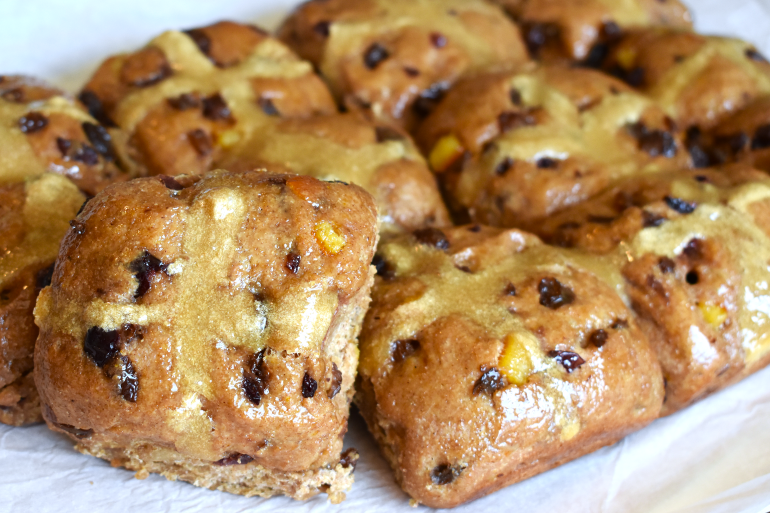
While hot cross buns are traditionally served on Good Friday, I think these are just a bit too much of a treat for such a somber day! With the tang of sourdough, the complexity of fresh milled whole grains, and the brightness from all the dried fruit, these soft and fluffy sourdough hot cross buns are truly a delight.
In our household, we enjoy them on Sundays in Lent and on Easter instead of traditional dinner rolls. They are a delicious complement to a roast, thanks to their slight, but not overpowering, sweetness. And I think the dried fruit and orange zest really make these and Easter ham a match made in heaven!
They’re also a great conversation piece, with layers of symbolism. The cross, of course, represents the crucifixion. The spices represent the spices used to embalm Jesus. And if you want to get a bit nerdy, the spices used are also very reminiscent of St. Hildegard of Bingen’s spices of joy (cinnamon, nutmeg, and cloves), which represents the joy of the Resurrection!

Do I need to use fresh milled flour for these sourdough hot cross buns?
If you can, I recommend it for the flavor and health benefits. I like to use hard red wheat berries for more of the complex “wheat” flavor, but hard white wheat will work too if you prefer it to be milder. A soft wheat berry will not give these buns the structure they require – stick to higher protein wheat berries.
However, if you do not have a grain mill, whole wheat flour or bread flour should also work if that is what you have available to you. Stick to high protein flours for the best structure and lift.
Are there other ways to make the cross on top of the sourdough hot cross buns?
I prefer the flour paste cross, but some people like to do a cross with icing instead. It seems that the icing is more common with hot cross buns sold in bakeries, at least in some parts of America! If you go the icing route, bake the buns after they rise, then ice them once they’ve cooled.
However, I’ve found that the icing makes these far too sweet and dessert-like for my taste. With the flour paste cross, you still get the symbolism without the sugar high and crash. It also is the more traditional option, and I’m all for tradition!
My dough is very sticky and hard to work with. What should I do?
The dough for these sourdough hot cross buns is quite sticky – you did not do anything wrong! Just do your best to shape it into rough ball shapes. They will smooth out as they bake.
Another option is to put the dough into the fridge for an hour (or up to overnight) after the bulk fermentation, but before shaping. This makes the dough significantly less sticky and easier to shape, but means that they will take a bit longer to for the second rise. I found that it did not diminish the quality, softness, or fluffiness of the final buns.

How do I make sure my sourdough hot cross buns stay soft and fluffy?
Be very careful when shaping the dough not to overwork it. I like to shape the dough into a square on an un-floured countertop and use a dough scraper to cut it into 12 pieces to minimize stretching and folding. Once I have my 12 pieces, I gently roll them in my hands into a rough ball shape. This seems to be the trick to keeping them quite soft and lovely!
Can I make these sourdough hot cross buns with discard?
If it is fresh discard, it should work but may take a bit longer for the yeast to become active. However, if it is very old discard, the yeast may no longer activate, which would cause these buns to fail to rise.
Instead of discard, I would recommend using active starter for quickest results. You can also use starter from the fridge (where my starter normally lives, unless I’m baking a lot), which will take a little longer but should still rise beautifully.
When should I make sourdough hot cross buns?
Hot cross buns are a traditional Good Friday food. However, I feel like they are better suited for Sundays and Easter because they are just so delicious! I think Passion Sunday and Palm Sunday are especially good candidates for hot cross buns as our focus turns toward the cross.
These sourdough hot cross buns are also delicious served with Easter dinner, as the dried fruit and orange zest complement a ham or roast wonderfully. As long as they piped with the flour cross and are not iced, they are not too sweet -at least not significantly more so than other dinner rolls. Or ice them and have them as a dessert!

Ingredients
- 1/2 cup raisins, roughly chopped – don’t worry about perfect chopping. I just quickly run a knife through the pile to make it easier for them to soak up the juice.
- 1/4 cup dried cranberries, roughly chopped – you can use more raisins instead
- 1/4 cup candied orange peel, chopped – you can use other dried fruit instead. I recommend making your own candied orange peels though (it’s easy)! If you do, save the syrup and the sugar you toss them in.
- 1 orange for zest and juice – the orange should yield about a 1/4 cup of juice. Don’t worry if there’s a little more or less.
- 450g hard red wheat – hard white wheat will also work!
- 50g sugar – if you make your own candied orange peel, you can use the sugar you tossed them in for some extra orange-y goodness!
- 2 tsp pumpkin pie spice – or mixed spice (more traditional, but less easily available in most American grocery stores)
- 1 tsp cinnamon
- 1 tsp fine sea salt
- 100g sourdough starter – active, from fridge, or relatively fresh discard will all work. However, colder and older starter/discard will take a bit longer.
- 250g (1 cup) whole milk, slightly warmed
- 1/4 cup butter, melted and cooled – make sure it is not too hot because we don’t want to cook the eggs or kill the sourdough starter.
- 1 egg, room temperature
- 1 egg yolk, room temperature

For Decoration:
- 40g soft white wheat – or other wheat berry. I like the contrast between the red and the white, but you can use whatever you have on hand!
- 1/4 cup water
- 1/4 cup apricot jam, warmed – or orange syrup from making candied orange peels!

Directions
Step 1: Zest and juice the orange. Heat up the juice, then soak raisins, dried cranberries, candied orange peel, and zest in the juice for at least 1 hour. Stirring occasionally can help speed along this process.

Step 2: Whisk together flour, sugar, pumpkin pie spice, cinnamon, and salt in a large bowl.

Step 3: Mix the sourdough starter, milk, butter, egg, and yolk in the mixing bowl of a stand mixer. You can do this by hand or with the mixer – up to you!

Step 4: Add the dry ingredients to the wet and mix until no large dry clumps remain. Then knead with a dough hook attachment for five minutes, scraping down the bowl halfway through.

Step 5: Add the soaked fruit to the dough and mix in, either with the dough hook or a wooden spoon, until evenly distributed.

Step 6: Shape the dough into roughly a ball shape – it will be sticky. Cover and allow to rise until doubled, about 8 hours. (Optional: After doubling, for easier shaping, put the dough in the refrigerator for a couple of hours or up to overnight. This makes the dough less sticky.)

Step 7: Divide the dough into 12 pieces and gently shape into balls. For soft and fluffy buns, do not overwork the dough – no stretching or folding, just get it into a roughly ball-like shape. I like to form the dough into a rough square, divide it with a bench scraper, then gently roll them in my hands to form balls.

Step 8: Place dough balls into a 9×13” casserole dish. Allow to rise for another hour (longer if dough is coming from fridge), until puffy.

Step 9: When the dough is nearly ready, preheat oven to 400°F. Mix the flour and water to form a paste for the crosses. Transfer the paste to a bag and cut a small hole in the corner, about 1/8-1/4.”

Step 10: Pipe crosses by piping across each row and down each column.

Step 11: Bake 15-20 minutes, until turning golden. The buns should have an internal temperature of 180°-190°F.

Step 12: While still warm, glaze with warmed apricot jam (or orange syrup reserved from making candied orange peels). Allow to cool a bit in the casserole dish before removing.

Step 13: Buns are best served warm with a slathering of butter, but are delicious plain and room temperature as well. They are best fresh but will keep for 3-4 days if stored in an airtight container.

Equipment
*Disclosure: I only recommend products that I use or would use myself. The links above are affiliate links, which means that I earn a commission (at no cost to you!) if you make a purchase using the link.

Sourdough Hot Cross Buns with Fresh Milled Flour
Enjoy these traditional English hot cross buns with spices and dried fruits to celebrate the end of Lent! Sourdough provides a natural leavening that keeps these buns soft and fluffy, while fresh milled flour gives it a wonderfully complex flavor.
- Total Time: 9 hours 30 minutes
- Yield: 12 buns
Ingredients
- 1/2 cup raisins, roughly chopped
- 1/4 cup dried cranberries, roughly chopped
- 1/4 cup candied orange peel, chopped – best if you make your own!
- 1 orange for zest and juice (about 1/4 cup of juice)
- 450g hard red wheat
- 50g sugar
- 2 tsp pumpkin pie spice
- 1 tsp cinnamon
- 1 tsp fine sea salt
- 100g sourdough starter – active, from fridge, or fresh discard
- 250g (1 cup) whole milk, slightly warmed
- 1/4 cup butter, melted and cooled
- 1 egg
- 1 egg yolk
For Decoration:
- 40g soft white wheat
- 1/4 cup water
- 1/4 cup apricot jam (or orange syrup from making candied orange peels), warmed
Instructions
- Zest and juice the orange. Heat up the juice, then soak raisins, dried cranberries, candied orange peel, and zest in the juice for at least 1 hour. Stirring occasionally can help speed along this process.
- Whisk together flour, sugar, pumpkin pie spice, cinnamon, and salt in a large bowl.
- Mix the sourdough starter, milk, butter, egg, and yolk in the mixing bowl of a stand mixer.
- Add the dry ingredients to the wet and mix until no large dry clumps remain. Then knead with a dough hook attachment for five minutes, scraping down the bowl halfway through.
- Add the soaked fruit to the dough and mix in, either with the dough hook or a wooden spoon, until evenly distributed.
- Shape the dough into roughly a ball shape – it will be sticky. Cover and allow to rise until doubled, about 8 hours.
- Optional: For easier shaping, put the dough in the refrigerator for a couple of hours or up to overnight.
- Divide the dough into 12 pieces and gently shape into balls. For soft and fluffy buns, do not overwork the dough – no stretching or folding, just get it into a roughly ball-like shape.
- Place dough balls into a 9×13” casserole dish. Allow to rise for another hour (longer if dough is coming from fridge), until puffy.
- When the dough is nearly ready, preheat oven to 400°F and mix the flour and water to form a paste for the crosses. Transfer the paste to a bag and cut a small hole in the corner, about 1/8-1/4.”
- Pipe crosses by piping across each row and down each column.
- Bake 15-20 minutes, until turning golden. The buns should have an internal temperature of 180°-190°F.
- While still warm, glaze with warmed apricot jam (or orange syrup reserved from making candied orange peels). Allow to cool a bit in the casserole dish before removing.
- Buns are best served warm with a slathering of butter, but are delicious plain and room temperature as well.
Notes
- Shaping the buns: I prefer to shape dough into a rough square on the counter, then use a bench scraper to divide it into 12 pieces. To shape the buns, I gently roll them in my hands into ball shapes, then place them in the casserole dish.
- Buns are best fresh, but will keep 3-4 days in an airtight container.
- Prep Time: 10 minutes
- Fermentation Time: 9 hours
- Cook Time: 20 minutes
- Category: Dessert, Side Dish
- Method: Baking
- Cuisine: English
- Diet: Pescatarian, Vegetarian
Nutrition Facts
Amount Per Bun
Calories: 298 kcal
Fat: 6g
Total Carbohydrates: 56g
Fiber: 2g
Protein: 8g
The nutrition data provided here is for informational only and is only an estimate based on an online nutrition calculator. It cannot be verified or guaranteed, and should not be used in the treatment of medical conditions. It should not be considered a substitute for a professional nutritionist’s advice This data should be interpreted and used at your own risk.





Leave a Reply